
Madison County Court Records After Arrest
After a Madison County jail arrest, two public-record tracks begin to separate. The jail and VINE track custody: where the person is held, whether release has occurred, and whether notification is available. The court record tracks the filed criminal case. The District Attorney's Office and the court process determine which charges move forward, whether a complaint is amended, whether a felony is presented to a grand jury, and whether the case ends in conviction, dismissal, plea, or another disposition.
A booking charge is not always the final filed charge. It can be reduced, amended, dismissed, replaced by a prosecutor's information, or superseded by an indictment. Use Madison County jail inmate records for custody and booking status, and use Madison County jail mugshots for booking-photo access rules. The court-records-after-arrest search belongs in the New York court system, the appropriate local criminal court, Madison County Court, or the County Clerk path depending on the case.
Find Court Records After Madison Arrest
The main online court-search channel in the research is the New York Unified Court System WebCriminal portal. WebCrims provides selected criminal cases with future appearances. It supports case identifier, defendant, and court-calendar searches. Coverage must be confirmed in the portal because older records, cases without future dates, sealed cases, and some court files may not appear through a public search.
- Confirm immediate custody through VINE or the jail phone line if the first question is where the person is held.
- Identify the arresting agency, approximate arrest date, and legal name from the jail record, notice, or FOIL response.
- Search WebCrims by defendant name, case identifier, or court calendar.
- Open the case result and read the filed charge, next appearance, court, and status details that are shown.
- If WebCrims does not show the case, contact the relevant court, Madison County Court, or County Clerk channel.
WebCrims is the statewide court-search interface used for selected criminal cases with future appearances.
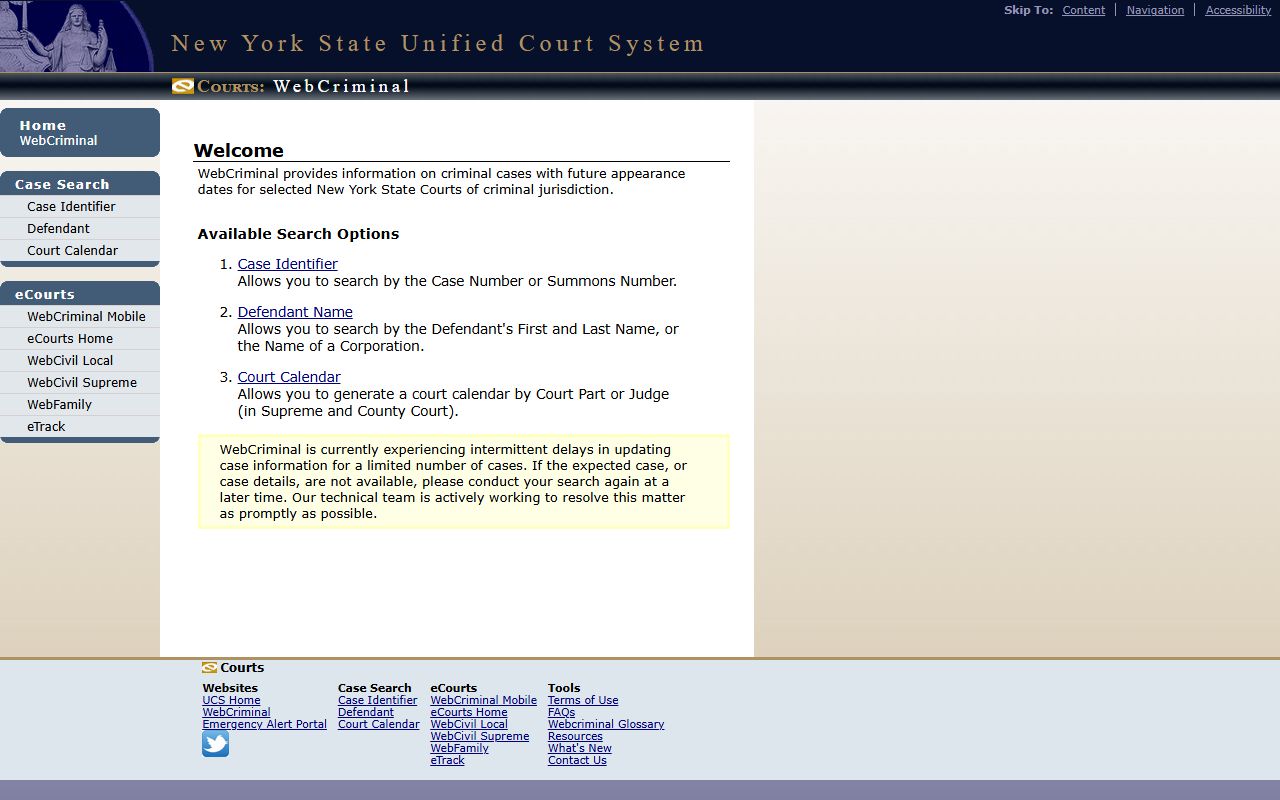
The portal is a court-case tool, not a county jail roster. Use it after checking custody when the question is filed charges or future appearances.
Madison County Court Search Fields
WebCrims field labels can vary by search mode, but the official portal categories identified in the research are Case Search, Case Identifier, Defendant, and Court Calendar. A name search works best when the legal spelling is known. A docket or case identifier is better when a citation, complaint, or court notice provides one.
| Field Label | Type | Required | Notes |
|---|---|---|---|
| Case Identifier | Tab or search mode | Optional path | Use a case, docket, or summons identifier when known. |
| Defendant | Tab or search mode | Optional path | Search by defendant name. |
| Court Calendar | Tab or search mode | Optional path | Search by court and date calendar. |
| Court / County | Selector | Usually required in workflow | Select the relevant court or county if exposed. |
| Defendant Last Name | Text | Required for defendant search | Use exact spelling. |
| Date of Birth | Date or text | Optional if exposed | Format depends on portal workflow. |
Charges Filed After Jail Arrest
A Madison County arrest may begin with a booking label, but the criminal case depends on the charging document filed in court. Misdemeanors and violations often move through local criminal court accusatory papers. Felonies may begin locally and later move by superior court information or indictment. The charging document is the bridge between police custody and the court record.
| Document | Who Uses It | What It Does |
|---|---|---|
| Complaint | Police or prosecutor path | Starts or supports a local criminal court charge. |
| Information | Prosecutor path | States a charge that can proceed in court. |
| Indictment | Grand jury path | Charges a felony or serious matter after grand-jury action. |
The Madison County District Attorney's Office is the local prosecutor's office for crimes filed in the county. Its official page lists the Veterans Memorial Building in Wampsville, mailing address P.O. Box 578, phone 315-366-2236, and office hours from 9:00 a.m. to 4:30 p.m.
Madison County Prosecutor Role
The Madison County District Attorney's Office handles the prosecution side after a jail arrest. Official directory material says Robert A. Mascari serves as District Attorney and assumed responsibility as District Attorney on August 1, 2025. The staff directory also lists chief, senior, first, and second assistant district attorneys, assistant district attorneys, investigators, a victim advocate, and support staff. Victim services may connect with custody notifications because the Sheriff's FAQ names VINE as a release-notification tool.
The Madison County District Attorney page identifies the local prosecutor's office tied to charges filed after an arrest.
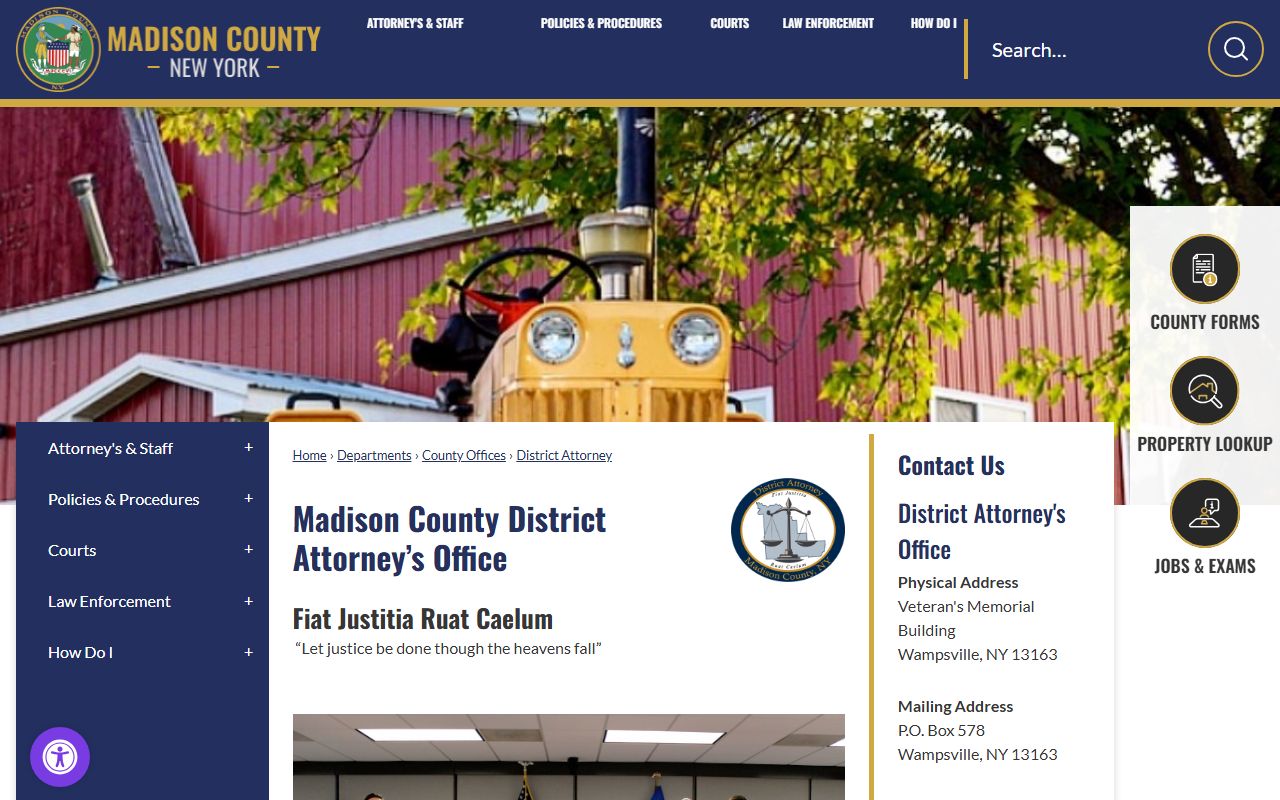
The prosecutor page helps distinguish filed criminal charges from the jail's custody status information.
Madison County Charge Status
Charge status is not fixed on the day of arrest. A charge can be pending at arraignment, amended after review, reduced in a plea, dismissed by the court, or replaced by a later accusatory instrument. A court record after a jail arrest should be read as a case timeline, not as a single static label from the booking desk.
| Status | What It Means |
|---|---|
| Pending | The charge is active and has not reached final disposition. |
| Amended | The wording, count, or statutory basis changed after filing. |
| Reduced | The charge level or count became less serious, often through plea or review. |
| Dismissed | The court or prosecutor ended the charge without conviction. |
| Disposed | The case reached a result, such as plea, conviction, dismissal, acquittal, or sentence. |
Bail Records After Madison Arrest
Bail and release orders are court-driven, not set by the jail lobby. The Madison County jail bail page says cash bail can be posted at the jail at any time with photo identification, personal checks are not accepted, and bail is forwarded by the facility to the court of jurisdiction. Credit-card cash bail is accepted through the listed payment route, with MasterCard, Visa, and Discover identified by the county page. A service fee applies through the credit-card company.
| Release Issue | Madison County Notes |
|---|---|
| Cash bail | Posted at the jail 24/7 with photo ID and no personal checks. |
| Credit-card cash bail | MasterCard, Visa, and Discover accepted through the payment company, with a fee. |
| Surety bond | County page lists bondsmen and says cost is usually 10 percent of bond amount. |
| Recognizance or conditions | Release without money or with conditions comes from the court. |
| Hold or detainer | Another legal basis can block release even if a bail amount exists. |
Warrants and Court Arrest Records
Madison County's official FAQ says outstanding warrant information is available through the Madison County Sheriff's Office mobile app. The website did not expose a separate browser-based warrant search table in the static pages inspected. A bench warrant tied to a missed appearance may be held by the issuing court, while an arrest warrant may lead to jail booking and a VINE custody result after the person is taken into custody.
Warrant questions need care. Calling the Sheriff's Office main line or the relevant court may be more appropriate than appearing in person without advice because an active warrant can result in arrest. For records, use FOIL, but FOIL is not a way to clear or resolve a warrant. After a warrant arrest, the court record may show the underlying case, the warrant event, and the next appearance if the case is covered and public.
Charges vs Convictions
A charge after arrest is an accusation. A conviction is a final legal result from a plea, verdict, or qualifying disposition. Court records after a jail arrest may show both at different points in the same case, so the status line and disposition matter as much as the charge label.
| Point | Charge | Conviction |
|---|---|---|
| Stage | Filed after arrest or by later document | Final result after plea or verdict |
| Meaning | An allegation pending court action | A legal finding of guilt or accepted plea |
| Can change? | Yes, it may be amended, reduced, or dismissed | Usually changed only through post-judgment process |
Sealed Court Records After Arrest
New York sealing rules matter after a dismissal or other favorable termination. Criminal Procedure Law Section 160.50 controls sealing when a criminal action terminates in favor of the accused. If a case is sealed, related arrest and booking records should not be treated as open public material. New York practice is not the same as broad expungement in every state, so use the correct term for the court action and record status.
| Issue | Sealed | Expunged |
|---|---|---|
| Public visibility | Restricted from normal public access | Often treated as removed or destroyed in states that allow it |
| New York arrest context | CPL 160.50 is the key researched rule | Do not assume broad expungement without court authority |
| Effect on mugshots | Can restrict related arrest and booking-photo access | Depends on the specific legal process |
County Clerk Court Record Fallback
The Madison County Clerk is Clerk of Madison County and New York State Supreme Courts. The office is at 138 N Court Street, Building 4, Wampsville, and the researched phone is 315-366-2261. The Clerk page describes court-record filing, indexing, copy services, and public search computers. It also links SearchIQS, which is useful for County Clerk records but is not a jail roster.
The County Clerk page is the local filing and copy-information source when a public court case is not found through WebCrims.
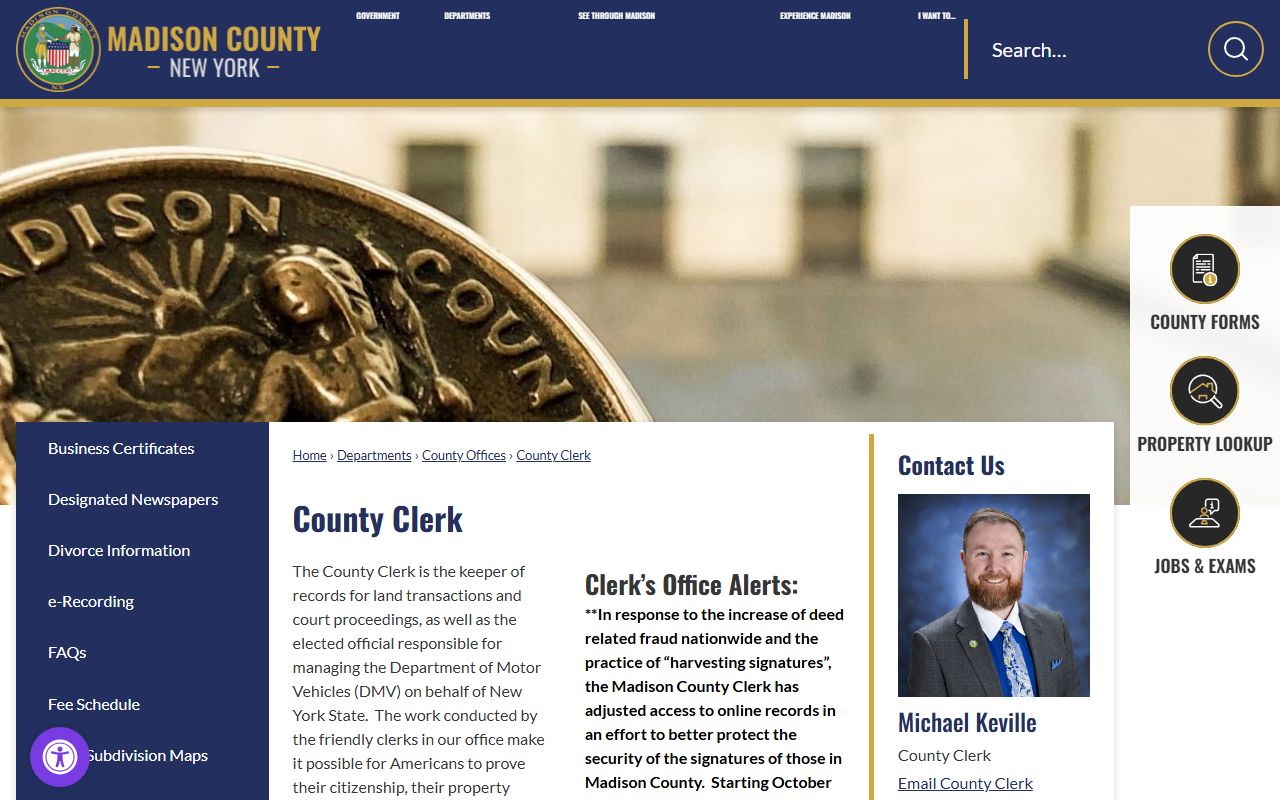
Use the clerk path for filed records, copies, and older matters that are not visible in the live criminal case search.
Criminal History Is Different
New York Courts explains that DCJS maintains Record of Arrest and Prosecution information, often called a RAP sheet, and that it is fingerprint-based. That is different from a public court-case search. A WebCrims result may help with a pending case or future appearance, but it is not the same as an official statewide criminal-history record. Employers, landlords, insurers, and other regulated users must follow FCRA and state-law rules instead of relying on informal court or jail searches.
Important: Public court lookups are not consumer reports and should not be used for FCRA-covered decisions.